
 •
Rating:
•
Rating:
THE REVIEW
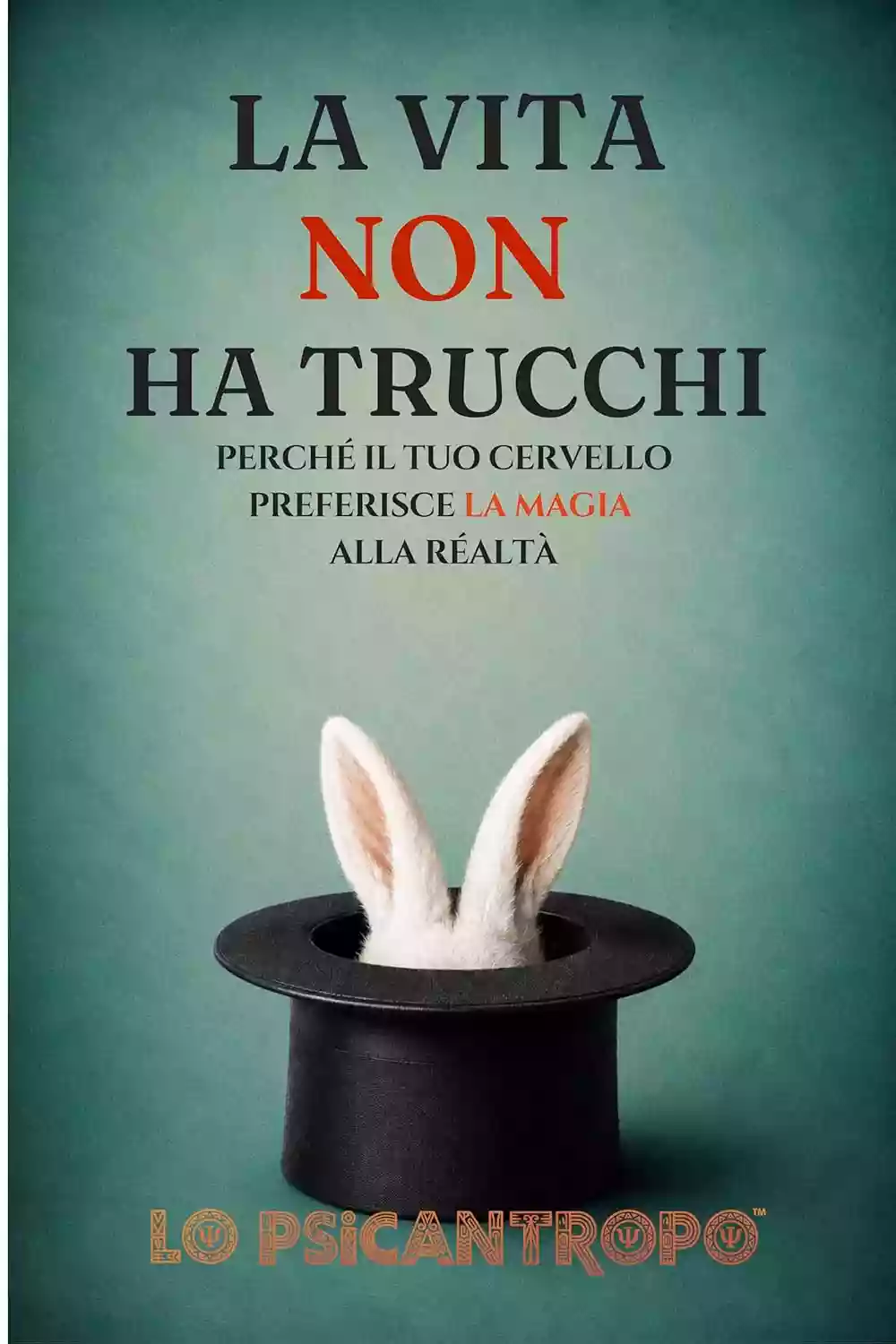
Life Has No Tricks
The book presents to the reader the variations that arise throughout one’s existence. As the author points out, these are not therapeutic pathways but observations of phenomena.
In the first chapter, we begin with Piaget’s observations – the child’s behaviorism and Piaget’s model of development – a fascinating theory that, in my personal opinion, seems excessive compared to the significance that family, environment, and external factors impose on development. My assessment is borrowed from the vision of Vigotskij, where development is seen as the result of interactions between the child and their environment—in other words, a Marxist view of cognitive and character formation.
The part about “magic” is very beautiful—it refers to the daimon within each of us to highlight individual peculiarities. The choice between the true and the livable is stated clearly, and it’s possible to relate just by reflecting on one’s own experiences.
In the second chapter, citing Frazer and the concept of sympatheia (συμπάθεια), the feeling together, the difference or discrepancy between two ways of interpreting the magical—similarity and contagion as modes of transmitting magic—is established.
The observation that ritual is associated with the imponderable introduces the concept of an outside force invoked to sell, in the sense of alienating, objects or practices by giving them a commercially valid and appealing value.
Paradoxically, contact extends to unpleasant things the aura that covers an object: the sweater, the balaclava, the weapon used, remain fetishes even after a long time. This method has been and is widely used by the Catholic Church, so that, for example, we have enough nails from the cross to build a palace.
The author’s stone has the same importance as the bracelet I wear, or the hat left on the car's hat rack—it’s not its commercial value that makes it significant, but the moment tied to the visual and tactile acquisition of the thing itself.
The space devoted to optical illusion and the weight of our perceptions clearly explains what we are able to produce and how any individual can be made to lean towards the “right” solution, giving the word “right” the meaning of an unconsciously conscious choice. Each person falls differently in front of the same visual trick, and everyone feels they are right.
Systemic correction is costly in terms of time; it is avoided because our preference for inward or outward pointing arrows persists despite further consideration.
From these connections derives the tendency to find patterns or non-existent modules through mere observation. Aristophanes’ clouds—before more thorough studies on the subject—are a prime example of this theory.
Within this context, sensations, false negatives and false positives, and induced memories all find their place, that is, things that never happened but are instilled as if they really occurred.
The narrative imposes and is imposed by the script of the event in which we played a part or were spectators. Phantom limb pain is the blatant example of the theory expressed ut supra.
From these previous analyses, the fourth chapter is generated—on the law of attraction, a thousand texts and many remnants: I desire something, I visualize it, I will obtain it; in short, this is the concept being promoted.
Theoretically, imagining a path is the mental rehearsal of how one intends to achieve it, with the methods and resources available. The user of manifesting, who lacks knowledge in the field, evidences a negative therapeutic process; consequently, the illness would tend to progress, just as collaboration would introduce positive variants in the disease’s course just as easily.
People with multiple sclerosis, a typical disease of the neural system, experience daily life in the two described ways: on the one hand, those who “give in”, on the other, those who commit themselves to limiting the damage caused by the degenerative phenomenon.
On The Secret, the magic of positive thinking is theorized, generating a current of thought that goes beyond science by attributing weight to related phenomena and making thought something divine: I think, therefore I can; if I think wrongly I am responsible for what happens. Pushed to the extreme, one could conclude that not winning the lottery happened because I didn’t pay attention to the license plate number on the first car parked outside my home.
In the following chapter, it is pointed out how coincidence, when what is visualized happens, influences thought. The die is cited, but we can use the roulette wheel or any other mechanism; mathematical expectation does not coincide with what actually happens.
The red and black positions can come up N times but, using the same reasoning, could alternate in frequency with no violation of the principle, thus leading to the idea of controlling the future. Allow me a digression: the past is in front of us, the present is what we’re living, and the future lies behind us—so said a Jew whose name escapes me now; the prophecy that does not come true or is unknown should be included among those who feel they are gods.
The use of rituals, attachment to superstition or religion, has positive effects on the psyche—the fact will remain unchanged in its developments but will appear directly linked to creative thinking.
The question of the next chapter: is superstition stupidity? It is addressed with facts that concern entire groups—for example, a bombing or an earthquake. The superstitious gesture unites people from all walks of life because it is generally associated with the wish to limit the damage that could occur by performing it.
Uncertainty, the sense of emptiness, evokes the ancestral memory of the ritual to be performed to palliate that lack or shortage of certainty; the ground missing under one's feet leads to what rationality and doctrine refute—superstition.
The lucky horn, (so named after the changes ordered during the Council of Nicaea to eliminate the phallic images of the god Priapus displayed in brothels), in order to make the object of veneration against adverse fate more acceptable to public decency, finds its explanation in the previous narrative.
The university exam, the thesis defense, the hospital visit—the object, hanging from keys or kept in the wallet, would emit positive energy, the positive thought that could straighten fortunes that would otherwise be doomed.
To recall an idea from the book: “magical thinking flourishes where control diminishes,” and this is the statement of principle linking Malinowski, Keinan, Witson.
The algorithm that reads our searches is yet another incentive to fill our mind with irrational impulses; the new cellphone will be, for example, something exceptional because it stores more information and simultaneously features unexpected functions, only to end up being used as much as a mechanical typewriter.
The suggestion is to counter magical thinking by rationalizing events, without being coercive in thought, with openness to possibilities other than those that promise a totally favorable outcome.
Following this line of reasoning, even assigning blame to an ungrateful universe fully belongs to magical thinking. The corollary is that both engineers and physicists may believe or not in horoscopes, even if their field of study is deeply rooted in mathematics.
Rotter’s introduction of Internal and External Locus shows how any event can be attributed to one root or the other. Toybach further developed the subject by correlating locus of control and paranormal beliefs, giving more emphasis to external control to justify them.
The value of the analysis presented can be found in justifying errors by attributing them to external, therefore unpredictable and hardly manageable, sources—thus absolving ourselves of possible discrepancies between what was desired and what actually happened.
The opposite danger lies in taking responsibility for facts unconnected or only barely related to one's choices; this phenomenon leads to the existential crisis of “I am the one who is wrong.” The author defines the external locus as a “cosmic painkiller,” showing how the function of mitigating guilt is demonstrated in the equilibrium between what we consider power and what we call fate.
The idea of fate written in the stars is useful for sizing up the scapegoat: the more we feel the weight of “wrong,” the more relevant destiny will become in our fate, so acting or not will almost become insignificant. “If God wills,” “patience”—these are phrases used to indicate the concept of absolution, different from “roll up your sleeves and get going,” “be the architect of your own destiny,” or similar ideas.
Drawing consequences from this overview of ideas is an effort we all try to avoid; a university degree does not shield behaviors from magical thinking—this is part of human nature.
We continue to live with our amulets, feel their absence when, for some reason, we forget to bring or use them. The lawyer who must represent a client in a separation case might carry with them a family photo—their own family—and here we enter the symbolism that the object represents.
Objects, words of encouragement—even if only mentally produced and unsaid—are powers attributed to something scientifically unproven, yet we use them as shields to ward off the present and future. We become the hoplites who armed themselves to go to war.
The rational being accommodates magical thinking in the mind, gives it space; it allows fantasy a necessary coexistence. It is customary to use this strategy to let off the repression that would otherwise be imposed on us by events.
We can differentiate superstition among educated people and the rest of the population; the manner may appear different, but the substance remains the same—between a favorite pen and a scapular.
The question now comes before the reader: can magical thinking acquire scientific consistency? Can trauma generate malign phenomena? This is immersion in the past according to Greek philosophy: the wound becomes psychodynamic and the lead actress of the disease.
Matè’s analysis of the damage from chronic stress (I do not wish to repeat myself regarding the concepts of stress in the course of neurodegenerative diseases) excludes phenomena related to other factors; smoker-cancer, cancer for genetic factors are two different views of the same disease.
At this point, it is up to the doctor to guide the patient on the locus—it will be science that acts on the substance or the perception of the patient. This makes the doctor’s words socially dangerous, and the affirmation of the power of words is fully strengthened. The rise of a pop psychosomatics is justified by the consumerism and the rush that characterize the poor desire to analyze, examining facts beyond the locus.
In MS centers, encouragement to act is never separate from drug prescription; the two things are linked. Neurologists do not sell solutions or placebos—they advocate certainties to people who would otherwise have lost them.
Homeopathy, believing in regeneration, is an internal locus just like the amulet hung with car keys.
When the source is a doctor—Matè was a physician for drug addicts—the conclusions that may be reached differ if the group is taken as the unit of measurement or if the individual becomes the subject of the same. When the writer is not just any charlatan, the process of canonizing the theory becomes easier; defenses are lowered, and what deserves further examination is simply taken for granted.
Matè, Piaget, use the idea of thought as a lever to change social and biological reality.
The conclusion, made by the author and, in my opinion, agreeable: without shifting focus, a product is created that is apparently sharable—but this creates an economy, sales, and induced similarities.
The idea of amplified sleight-of-hand is the unifying reason of the narrative; the real trick has no tricks but consists in a series of factors producing a visible and livable result.
Theorizing a boundless rationality is useless and harmful; recognizing the limit and appreciating its existence becomes balance—I touch my bracelet or the hat on the hat rack because it relaxes me, magical thinking brings color to the world.
This book is not the seed of disillusionment; it is a launching pad for anti-rejection reflection. As the author says, “life has no tricks, but it has you, with your ability to see it work,” and so be it.
Loading comments slowly
Summary by Bot
A thoughtful review praising Corrado Manenti’s compelling book. Highlights the book’s approach to truth and authenticity in life. Notes the relevance for contemporary readers. Emphasizes the book’s resonant, honest narrative voice. Strongly recommends the work to literature enthusiasts.
Corrado Manenti
Author of the nonfiction book “La vita non ha trucchi,” focused on magical thinking, superstition, and perception through a rational lens.01 Reviews
