
 •
Rating:
•
Rating:
THE REVIEW
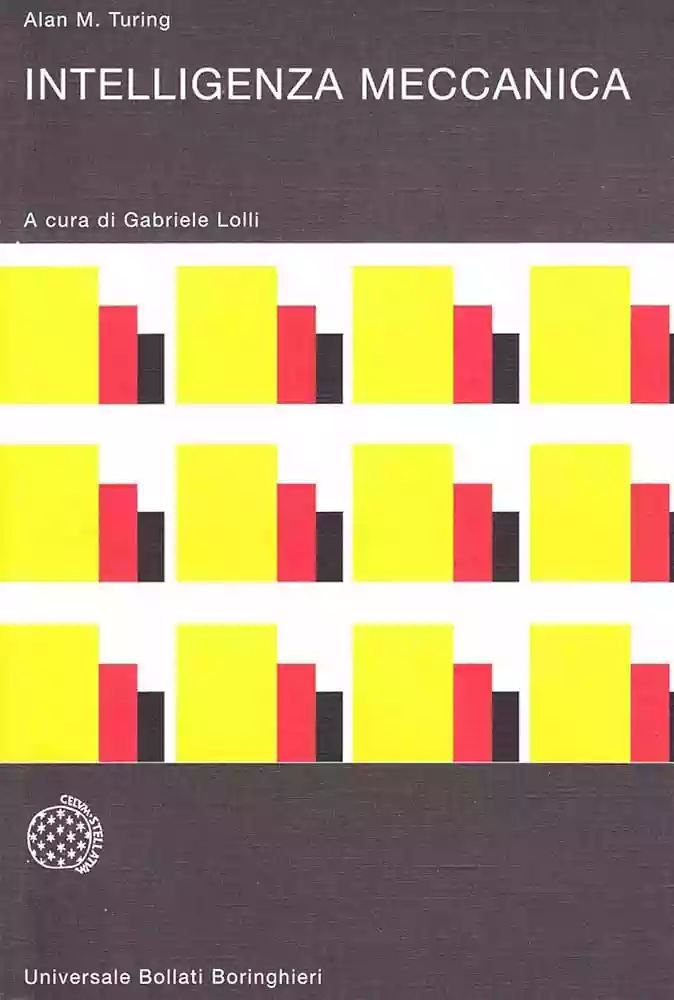
Alan Turing, one of the greatest visionaries of the last century, laid the foundations for contemporary computer science and artificial intelligence; does it still make sense to read his writings today without sounding anachronistic? Published in 1994, this book collects four of his writings and lectures spanning from 1945 to 1950. The central theme of this book is the development of what would, in the years to come, become artificial intelligence, an element that now, in 2026, dominates our society for better or worse.
In the first writing included in this book, which corresponds to the first chapter, the theoretical and technical foundations of calculation using binary code and related adders are explained; it is likely a bit too technical for those without much background in the field, but precisely for this reason, it is an excellent lesson, also from an educational perspective. This opening chapter is very useful in the context of reading the whole work to understand the development process of certain systems; in fact, as we will see, it is possible to observe the process of theoretical development of systems with a solid technical basis. The second chapter contains a lecture delivered at the London Mathematical Society in 1947, the main topic being an explanation of how digital computers function; reading these pages, it immediately becomes clear that, despite encountering a text written almost eighty years ago, the manner and the concepts are perfectly compatible with modern computer science. Based on this, we can observe—even without reading further—how Turing’s genius was so comprehensive and precise that his theories required virtually no modifications over the years during the practical development of certain ideas. Someone unaware of the date of this lecture, when reading this chapter, because of the style and the accuracy of the details, could easily believe they are reading a text from the 1980s. The third chapter moves onto the specific concept of creating “intelligent machines”; written in 1948, this is an extremely detailed essay which, if at the time some statements may have been mere conjecture, is, eighty years later, a perfect lesson on the functioning of algorithms that, having developed over the years, created many of today’s digital conveniences (Google, social networks, etc.). Reading here, although still technical, is very smooth and never heavy; I believe that even today this can be a very valuable work for anyone wishing to research the origins of certain elements we take for granted in the 21st century. The fourth and final chapter resumes this concept, comparing it to the reality of its period (1950); the author highlights, in some passages, a certain skepticism about the legitimacy of these “intelligent machines” from a moral point of view, yet the arguments both for and against are quite impartial, and it is up to the reader to decide whether all this evolution has truly been progress or rather a double-edged sword.
To conclude, how can we answer the question I posed at the beginning? The answer is yes, it absolutely makes sense to read his works today; just as understanding the history of certain countries and cultures requires researching facts around the great wars, to thoroughly understand certain mechanisms of contemporary society, one inevitably has to pass by Alan Turing. This book, as already mentioned above, is an excellent educational reading, and for those studying computer science, it could serve as a great foundation for learning about its history; moreover, it is still a very relevant text for holding a class in 2026. Although it is a book “assembled” several years after the author’s death as a collection of some of his most renowned writings, it is a wonderful starting point for understanding Alan M. Turing, a genius to whom all of us owe great thanks.
A technical read? Absolutely yes, but with a minimum of background knowledge, it is perfectly approachable.
Who is it recommended for? For those who want to understand the foundations of computer science and the algorithms behind artificial intelligence; for computer science students as an educational text.
Loading comments slowly
Summary by Bot
This review discusses Alan M.Turing's book 'Intelligenza Meccanica,' highlighting its significance in the history of artificial intelligence. The reviewer rates the book highly, appreciating its deep insights into machine intelligence. The work is noted for its lasting impact on technology and computing. The discussion is informative and rooted in admiration for Turing's pioneering ideas.
Alan M.Turing
British mathematician and computer scientist (1912–1954), pioneer of computation and AI; key codebreaker at Bletchley Park; author of the 1950 paper proposing what became known as the Turing test.00 Reviews
